From Robinhood to Arc, Uniswap Catches the Flood of Traffic, v4 Accelerates Liquidity Grab
 Tapbit Wire
Arc mainnet had a hot start, initially capturing the market's attention, but could not escape being a "one-day wonder". In this brief on-chain carnival, Uniswap captured the traffic and emerged as the winner.
From Robinhood Chain to Arc, the growth dividends from new chain traffic are becoming an important driver of Uniswap's recent growth. At the same time, v4 is accelerating its catch-up with v3, gradually becoming a key force for Uniswap to expand its liquidity landscape.
Cashing in on the Robinhood Chain Dividend, Uniswap Captures Arc Traffic
Over the past month, UNI has experienced a strong rally, with cumulative gains reaching 108.9%, rising from $3.2 to $6.9. Even amid the recent overall crypto market correction, UNI has continued to rise against the trend. Behind the sustained price increase, besides the recovery of market sentiment, Uniswap's growing trading volume and protocol revenue have become important fundamental support.
DeFiLlama data shows that over the past month, Uniswap processed a cumulative trading volume of over $79.5 billion, exceeding the combined trading volume of PancakeSwap, PumpSwap, and Aerodrome during the same period. In the last 24 hours alone, Uniswap's trading volume was nearly $3.86 billion, several times that of the second-place PancakeSwap.
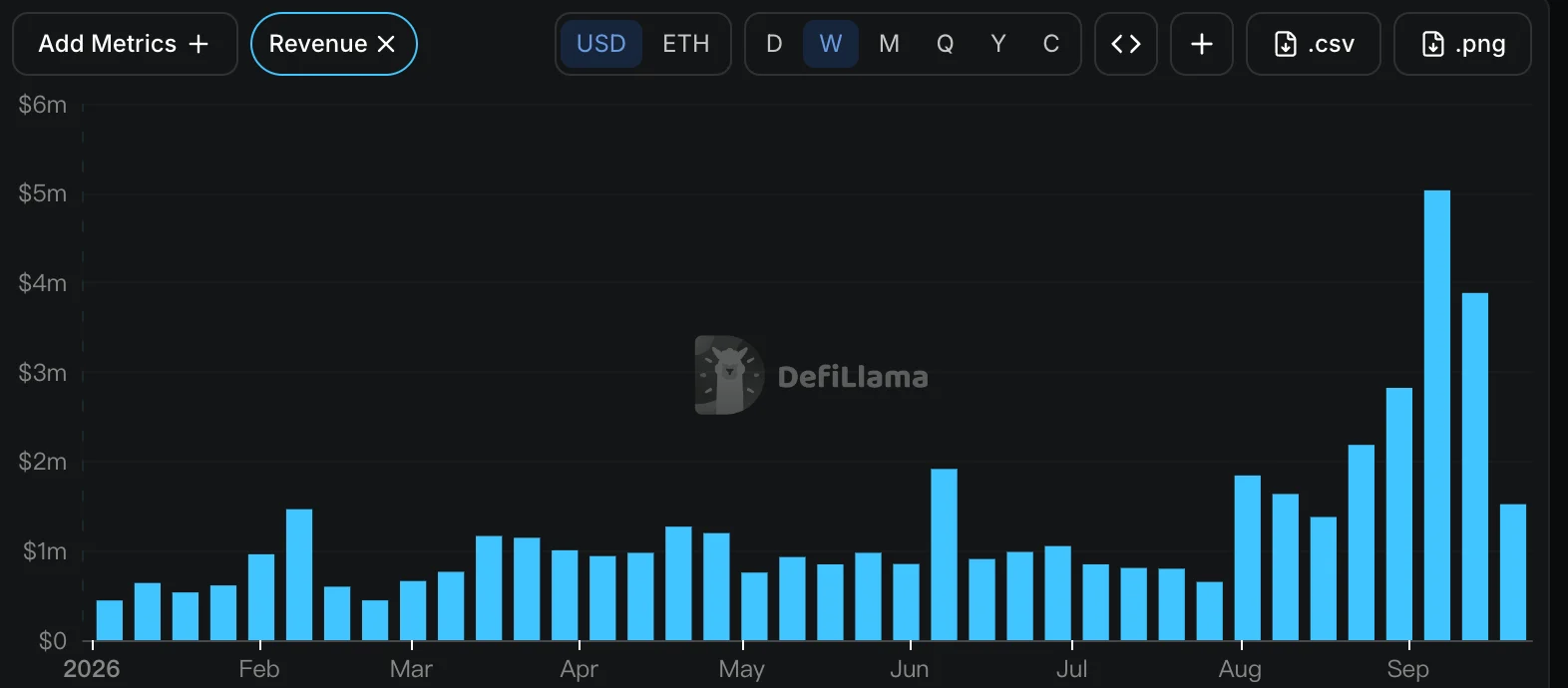
The continuous growth in trading volume has also directly driven an increase in Uniswap's protocol revenue. DeFiLlama data shows that Uniswap's protocol revenue reached $23.15 million in the past quarter, and $5.26 million in the past 30 days, ranking first among DEXs in revenue.
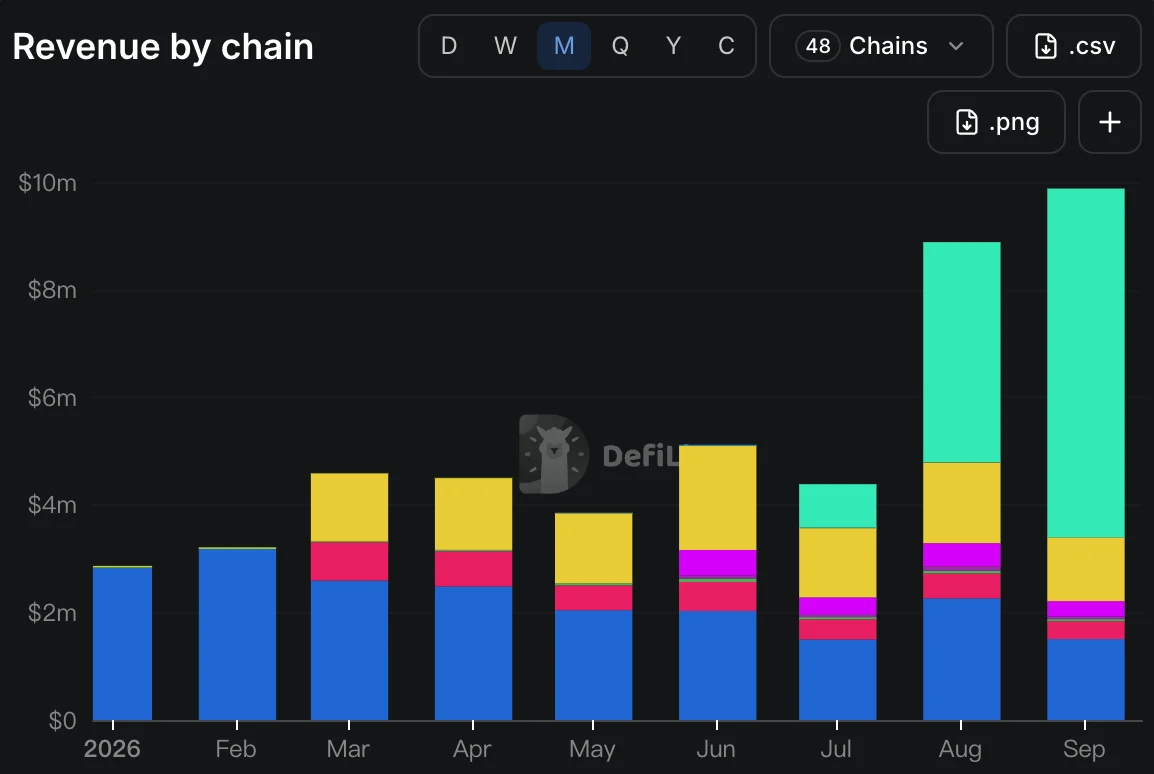
Currently, Robinhood Chain has become the main driver of Uniswap's recent revenue growth. Taking September data as an example, Robinhood Chain contributed approximately $6.48 million in protocol revenue to Uniswap this month, accounting for 65.5% of the total revenue for the period. Although revenue from Robinhood Chain has declined from its previous peak due to the cooling of the Meme coin trading frenzy and the withdrawal of some high-fee pools, Uniswap's overall protocol revenue has not seen a significant drop.
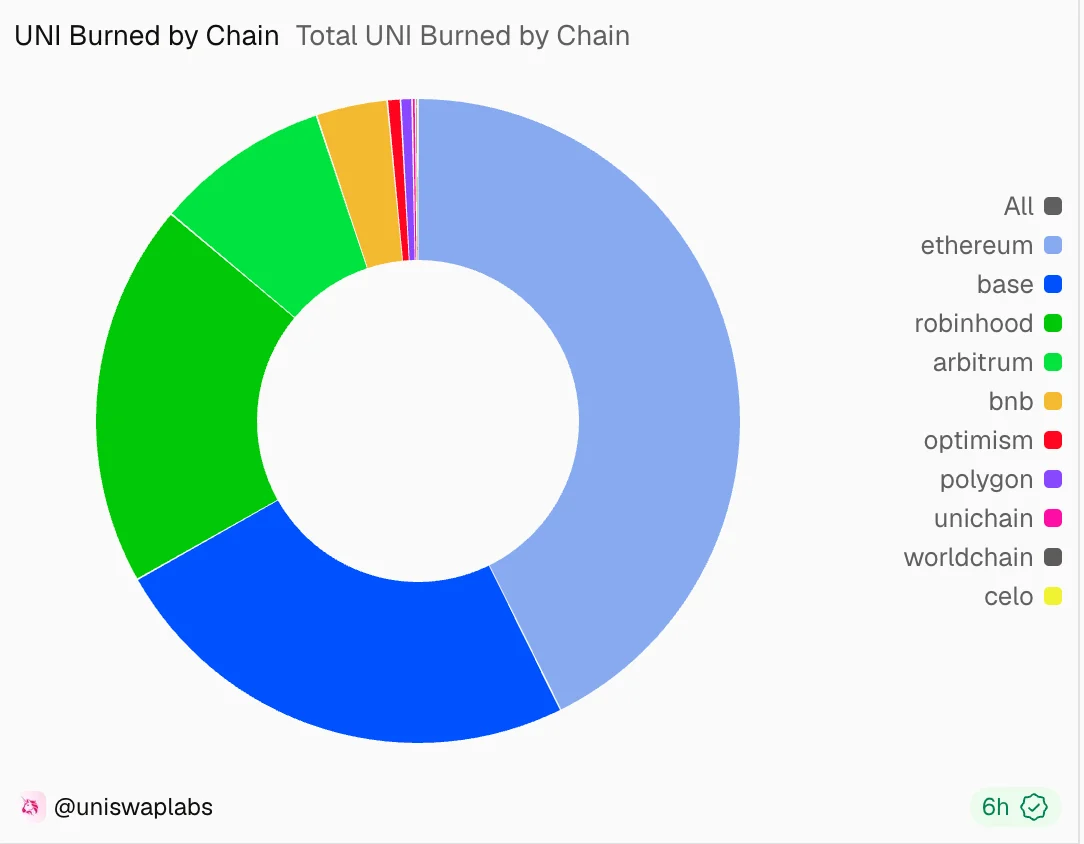
After the fee switch on Robinhood Chain was activated at the end of July, the rate of UNI burning accelerated significantly. Dune data shows that in less than two months, UNI burns contributed by Robinhood Chain accounted for 19.3% of the total burn. Looking at single-day data, this proportion is even higher. On September 17, UNI burns originating from Robinhood Chain accounted for half of the day's total burn, significantly higher than other networks like Ethereum and Base.
Leveraging its liquidity and user base as a top DEX, Uniswap has also become a priority cooperation target for new chains vying for traffic. On the first day of the Arc mainnet launch, Uniswap announced full integration with Arc and became its preferred DEX. As trading activity on Arc rapidly heated up after its launch, Uniswap gained a new traffic entry point for transactions.
Dune data shows that on September 16, Uniswap's trading volume on Arc exceeded $410 million. In comparison, Uniswap's trading volume on the first day of the Robinhood Chain mainnet launch was approximately $70.5 million. Looking solely at the first-day trading volume on the mainnet, the traffic Arc brought to Uniswap was significantly higher than that from Robinhood Chain. However, this round of Arc trading frenzy brought more incremental traffic to Uniswap. Since Uniswap has not yet activated the fee switch on Arc, this portion of trading volume cannot currently be converted into UNI burns.
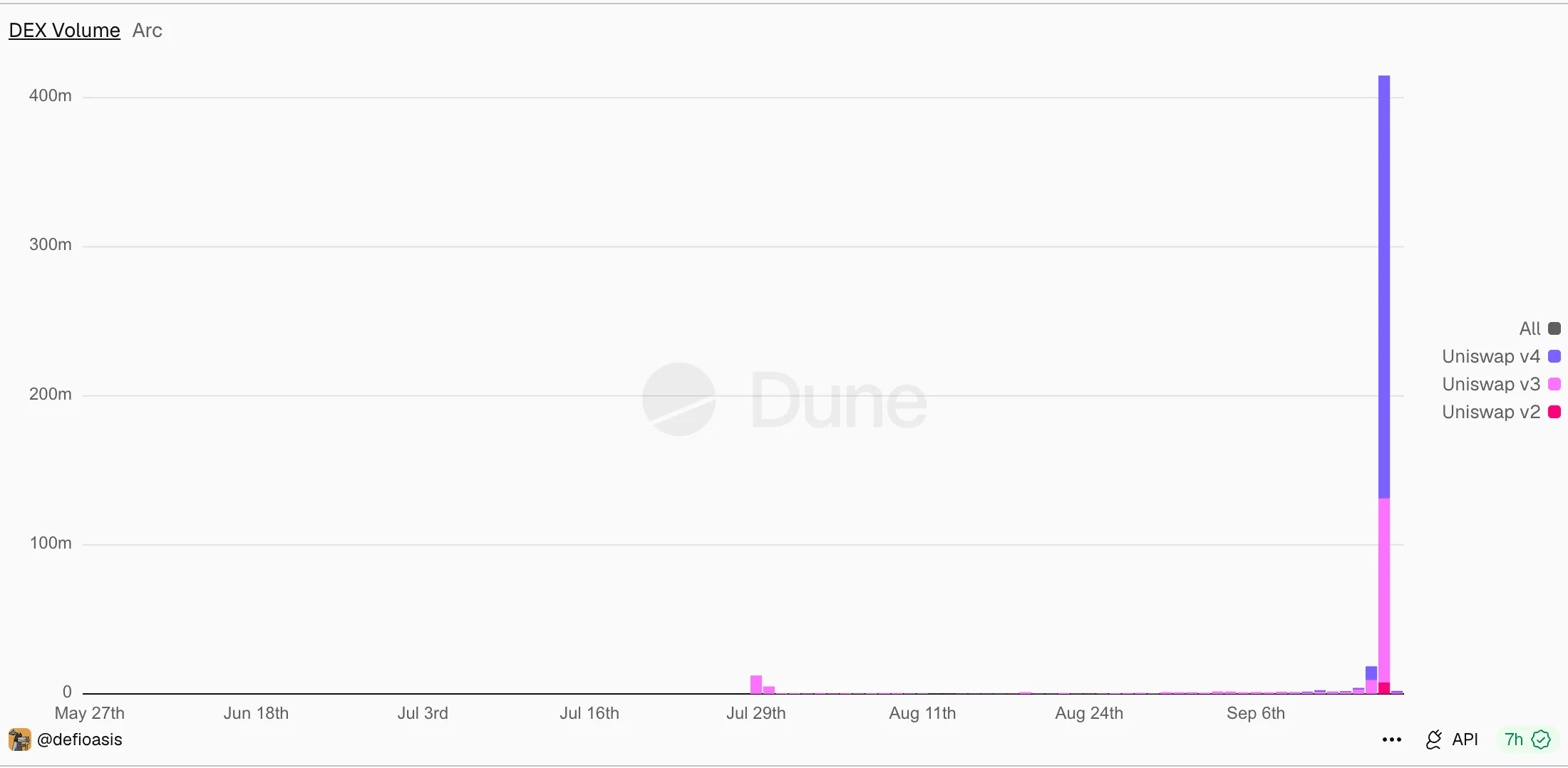
Meanwhile, as Arc ecosystem tokens generally experienced significant pullbacks, on-chain liquidity has also decreased, creating uncertainty about whether the short-term trading frenzy can be sustained. For Uniswap, whether Arc can transform from a short-term traffic entry point into stable trading volume and sustained revenue, similar to Robinhood Chain, remains to be verified by subsequent market performance.
New Chain Traffic Boosts V4 Growth, Hook Mechanism Exposed to Malicious Risks
Uniswap has returned to the center of the on-chain liquidity competition, and the rise of V4 is becoming an undeniable driving force. Among these, Hook, as one of V4's core innovative mechanisms, is gradually becoming an important growth point for Uniswap.
Blockworks data shows that Uniswap v4 is continuously narrowing the trading volume gap with v3, with its latest weekly trading volume share rising to 48%, approaching v3's 52%. In terms of fee revenue, v4's weekly fee revenue share has also increased from 8% at the end of July to 25%, while v3's share dropped from 87% to 67% over the same period.
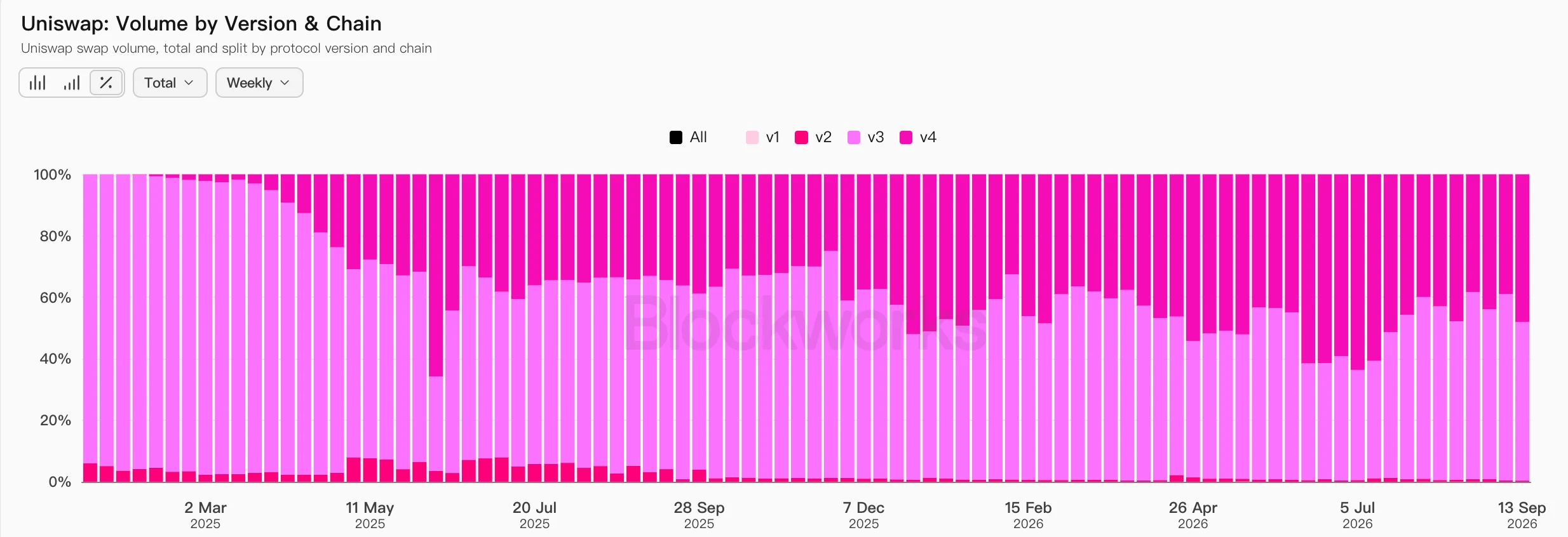
The penetration speed of V4 on new chains is noteworthy. On Robinhood Chain, v4's weekly trading volume share has reached 42%; on Base, this ratio is 11%, and on Arbitrum and Optimism, it is 18% each. Even on the newly launched Arc, v4's contribution to single-day trading volume reached 29.7%.
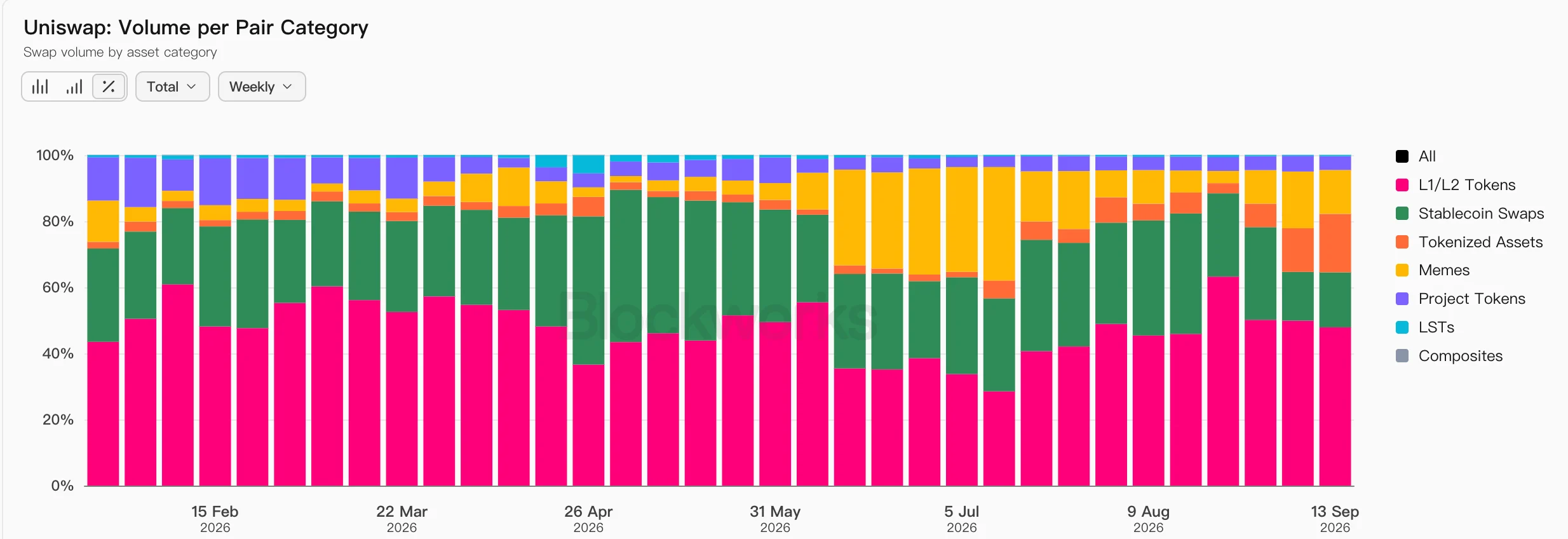
Besides the continuous increase in market share, the asset structure of v4 trades is also changing. In July, v4 trading was mainly concentrated in Meme coins, stablecoins, and L1/L2 tokens; by August, stablecoins, tokenized assets, and Meme coins became the main trading types, with the trading share of Meme coins decreasing compared to the previous month. Stablecoins continue to occupy an important position in v4 trading. This is because the underlying execution efficiency and fee structure of this version are better suited for stablecoin trading needs.
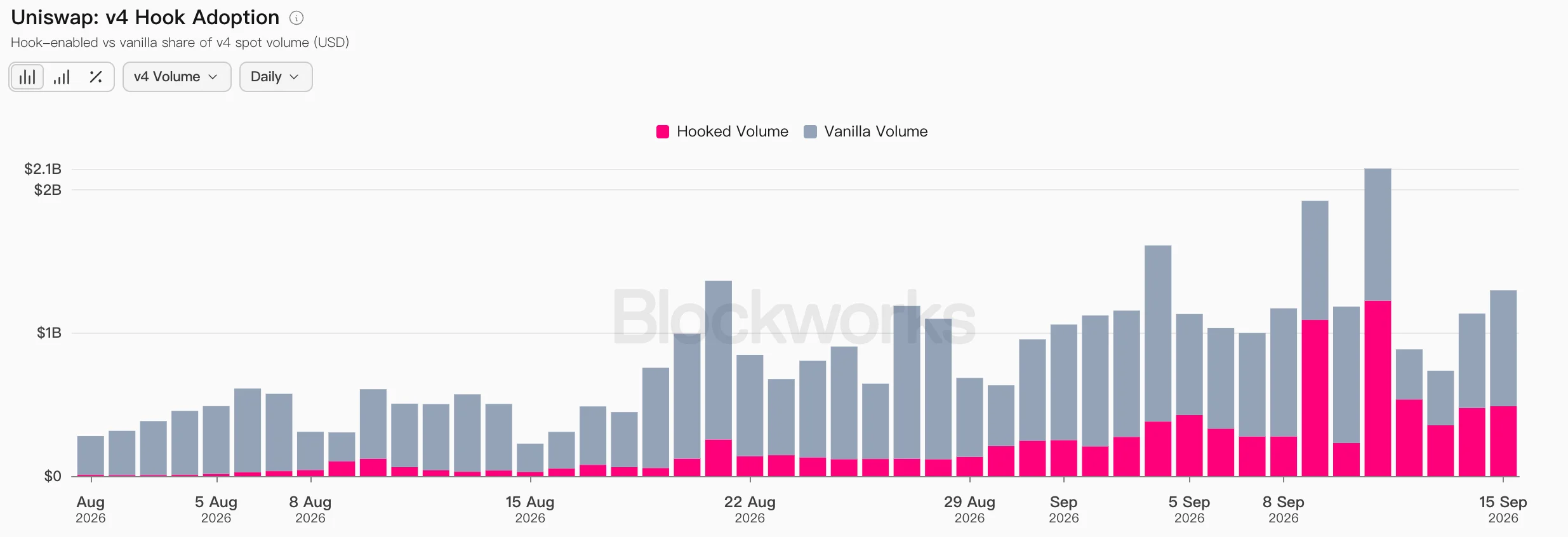
With the rapid expansion of the v4 version, Hook trading is also accelerating. Blockworks data shows that currently, most of v4's trading activity still comes from standard liquidity pools, but Hook-related trading has been steadily climbing since August, now accounting for 44%, whereas it was previously at single-digit levels.
Hook allows developers to customize features for liquidity pools, such as dynamic fees, token issuance mechanisms, RWAs, and permissioned pools, based on different assets and trading scenarios. Compared to v3's relatively fixed fee configuration, v4 offers a more flexible trading mechanism, enabling liquidity pools to be tailored to specific scenarios.
Robinhood Chain is an example. As an L2 focused on assets like tokenized stocks, its Uniswap v3 and v4 cumulative trading volumes have reached $24.3 billion and $23.35 billion respectively, with the scale being quite close. In the latest weekly trading volume, v3 accounted for 58%, while v4 reached 42%, narrowing the gap compared to the initial launch period. This also indicates that v4's growth is not just due to version upgrades causing trade migration, but is also related to the emergence of new chains, new assets, and customized trading demands. As more assets and trading scenarios enter the chain, the Hook mechanism will also help Uniswap expand into more liquidity scenarios.
However, as the application scale of v4 and Hook expands, related security risks are also drawing attention. 0x protocol recently stated that it has observed a significant increase in the number of malicious Uniswap v4 Hooks. Such Hooks might display favorable prices during the quote request phase but change the actual execution price at settlement, misleading aggregators, wallets, and trading applications, ultimately harming user interests.
0x stated that it has routed 81.92 million transactions this year, with a total trading volume of $42.67 billion, of which approximately 70% involved Uniswap liquidity. The protocol conducted static analysis, dynamic analysis, and analysis of trade data on 84,163 Hooks across 6 chains. Based on this, it judged that only 19.4% were benign Hooks, 54.2% were classified as malicious, and another 26.4% potentially exhibited malicious behavior.
The protocol also pointed out that some malicious Hooks distinguish between quote requests and real trading scenarios by detecting the Ethereum Virtual Machine (EVM) environment or using random fee charging methods. This means that the price users see during the quote phase may not be honored at settlement, and the actual value of the assets received could be up to 50% lower than the quoted price. In response to this issue, 0x stated that it has implemented measures such as advanced detection and liquidity pool reviews to prevent relevant pools from entering its routing system, and reminded routers, applications, and users to pay attention to whether quotes are consistent with actual execution results.
In response, Uniswap founder Hayden Adams responded that the so-called "routing to malicious Hooks" issue stems from technical mishandling, and teams can seek assistance to resolve it. He also emphasized that Uniswap v4 Hooks have unlocked significant innovation potential and recommended that developers use the Uniswap API. He explained that the Uniswap API supports obtaining the best market prices, avoiding malicious Hooks, and accessing Uniswap's full liquidity without additional routing fees. Additionally, the API supports cross-chain swaps and integrates external liquidity through aggregator Hooks, further expanding into a full-fledged aggregator.
From the increase in v4 trading share to the sustained growth in Hook transaction proportion, Uniswap is expanding into new chains and new asset markets through more flexible liquidity mechanisms. However, as customization features become increasingly rich and asset boundaries continue to expand, balancing innovation and security will be a challenge for Uniswap.