Failed to raise a lifeline: Once-star L1 Linera quietly exits, three years of airdrop farmers' "hard work" gone to waste
 Tapbit Wire
Linera was once a collective memory for airdrop farmers. The star L1, which had long kept the community hooked with airdrop expectations while its mainnet launch kept getting delayed, ultimately faded away quietly after an emergency fundraising effort failed.
As the wave of blockchain shutdowns spreads, Linera's closure sounds yet another alarm: elite teams, star capital and grand narratives are no longer enough to sustain market confidence.
Even a lowered fundraising bar couldn't win buyers over, as the once-star L1 heads toward shutdown
After a long silence, Linera was once again widely discussed — not because of a mainnet launch, nor because of airdrop rules, but because of its shutdown.
At the end of last month, Linera loudly proclaimed it would build "the next Hyperliquid" and teased the upcoming launch of its LNRA token sale. On September 1, Linera officially opened the LNRA community round, pricing the token at $0.16, corresponding to a $1.6 billion FDV, while offering early participants a discounted price as low as $0.02.
However, the market response fell far short of expectations. Subscription progress in the community round was slow, and overall enthusiasm was clearly lacking. In the end, 617 participants from 69 countries and regions committed to subscribing roughly $848,000 — not only far below the $8 million fundraising cap, but even failing to reach the $1.5 million minimum target. Although the size of this public sale was not large compared with crypto project raises of tens of millions of dollars in the past, Linera still failed to meet its minimum fundraising requirement, showing just how cold the market was.
On September 19, Linera founder Mathieu Baudet announced on Discord that, because the LNRA token sale did not reach the minimum amount required to complete the sale, all subscription payments had been refunded and the project would immediately cease operations. The team had previously tried to raise emergency funds to keep operating until mainnet launch, but failed to raise the needed capital, ultimately leading to the project's closure.
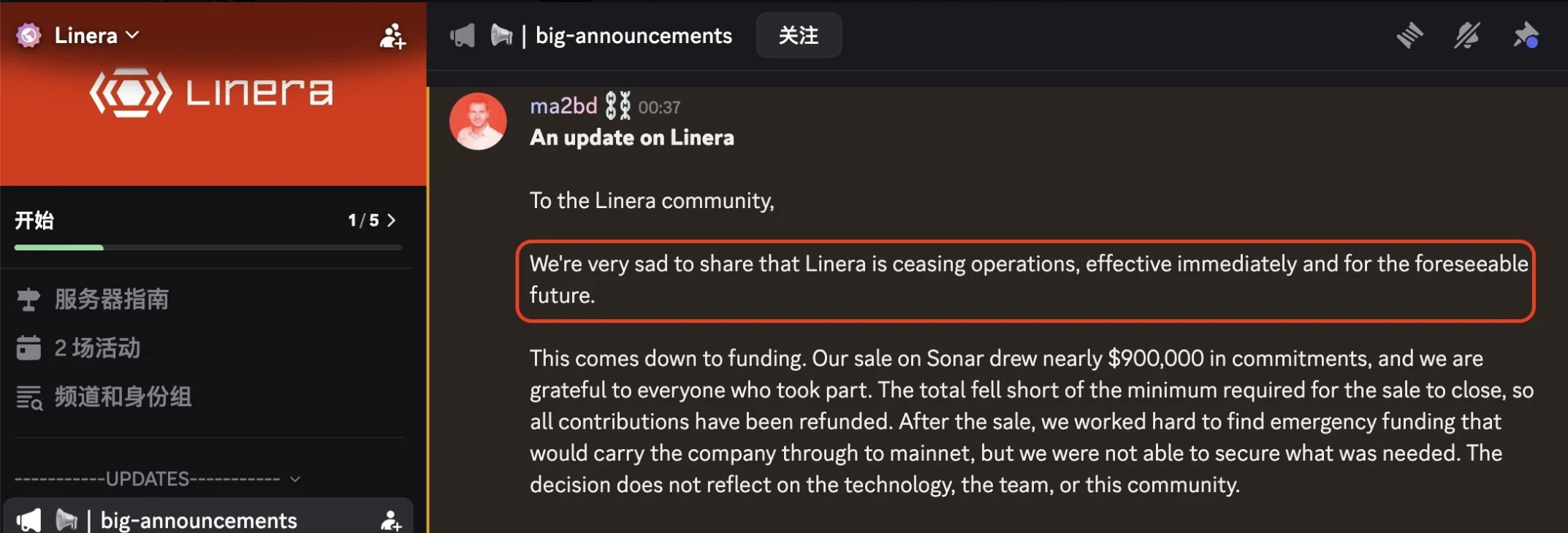
From loudly teasing the token sale to ceasing operations because the raise fell short, Linera's sudden shutdown caught the market by surprise and turned years of waiting by many airdrop farmers into nothing. From testnet interactions and completing tasks, to collecting badges, attending weekly meetings and accumulating Discord roles, long-term participation in the Linera ecosystem had become a daily routine for many community users. Now that the project has suddenly halted, these efforts have yielded no returns.
Some users posted on social platforms saying they had continuously participated in Linera ecosystem interactions over the past three years, investing a cumulative total of roughly 40,000 to 80,000 MGS, publishing more than 100 posts, attending 69 community events and collecting 30 badges — but in the end their "returns were zero," and they never even got the chance to check for an airdrop.
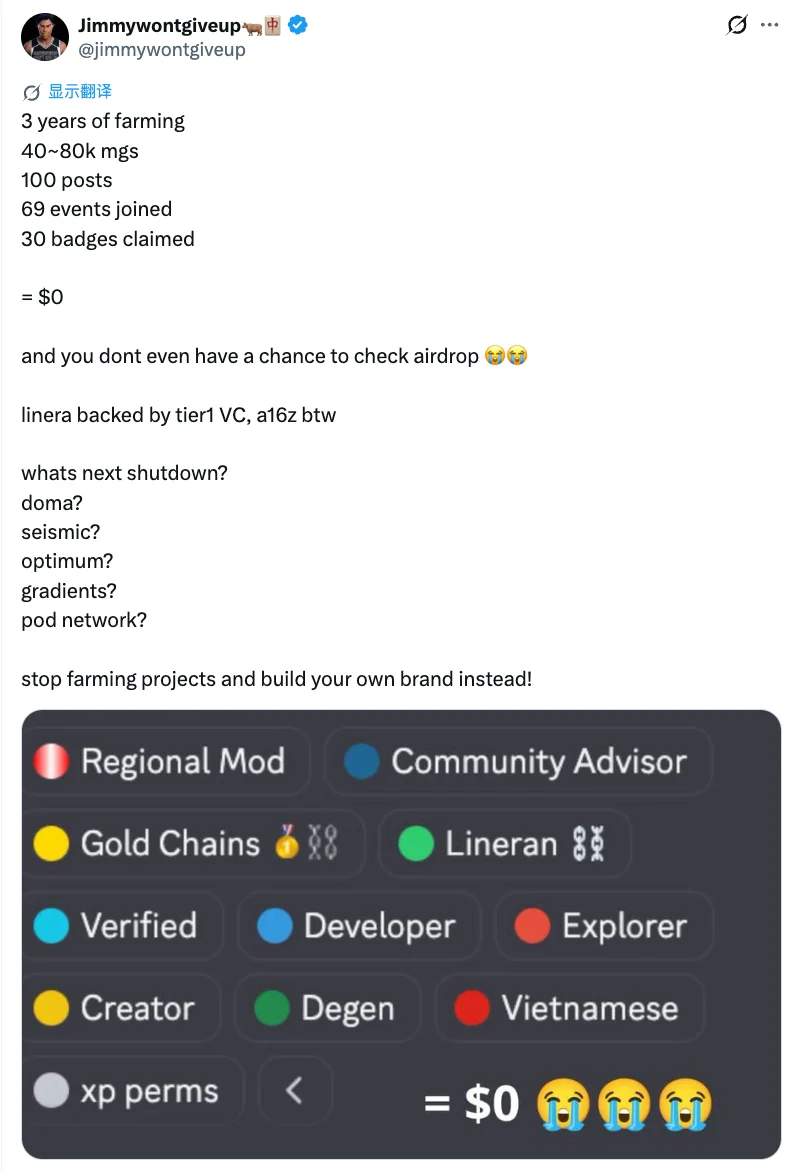
Other users questioned how Linera, which had backing from top-tier VCs like a16z, could go through several years without officially launching its mainnet and ultimately shut down over funding issues. "Four years without a mainnet launch and the funds are already exhausted — who's next?" Similar voices began spreading through the community. Some users put it bluntly: "VCs dump ghost chains onto retail and walk away," while others lamented, "What we farmed were points, but what Linera farmed was our time."
Some community users even compared Hyperliquid and Linera, arguing that the former had its product running first with capital flowing in afterward, while Linera was more like "telling the full story first," only to end up relying on a community round to keep operating.
Today's Linera may be hard to associate with a star L1 anymore. But since the project launched in 2022, from its team background to its funding lineup to its Move ecosystem narrative, Linera had collected nearly all the labels of a hot public blockchain at the time. Even before truly entering large-scale application, Linera still gained considerable market attention and community expectations.
Linera was founded by former Meta researcher Mathieu Baudet, and the founding team's background gave the project built-in buzz from day one, once earning it a place alongside Aptos and Sui as the "Move trio." In 2022 and 2023, Linera completed two funding rounds totaling about $12 million, with a16z participating in both, and other investors including Borderless Capital, GSR, Matrixport Ventures and Flow Traders — a rather impressive capital lineup. Yet none of this halo became a moat for Linera to weather the cycle.
At present, Linera is gradually shutting down its applications and Discord community. Users' point balances will still be recorded, but the team cannot promise that these points can be redeemed for any rights in the future. As for protocol development and app launches, the team said it still hopes to continue advancing them in the future, but cannot give a clear timeline for now.
Blockchains enter a survival war, with sustainable revenue generation as the key
Linera's curtain call seemed sudden, but it was not without warning signs.
As more and more blockchains go from the spotlight to silence, or are even forced to shut down or pivot, what the industry is going through may be more than just a market correction — it is a re-examination of liquidity, business models and value capture.
In recent months, Layer 1 and Layer 2 projects such as Harmony, Scroll, Moonbeam, Secret Network, Saga, Vanar and Zero have successively announced shutdowns or pivots, including some industry pioneers that were once closely watched. They had attracted market attention through technical narratives, funding lineups and ecosystem incentives, and had at one point accumulated considerable on-chain liquidity. Yet when market heat faded and incentives gradually withdrew, their trading volume and user activity began to plummet, with some even becoming veritable "ghost chains."
Especially after new chains backed by traditional giants, such as Robinhood Chain, entered the fray, they offered the market's capital and users more choices, accelerating liquidity migration across different ecosystems. For public blockchains lacking differentiated advantages, once users and capital drain away, rebuilding an ecosystem often requires even higher costs.
Under the head effect, the survival pressure on small and mid-sized blockchains has further intensified. DeFiLlama data shows that the top ten blockchains — including Ethereum, Solana, Base and BNB Chain — account for roughly 90% of the blockchain market's share. In such a competitive landscape, relying solely on new-chain narratives, short-term incentives or token issuance to attract capital has become increasingly difficult to turn into a long-term advantage.
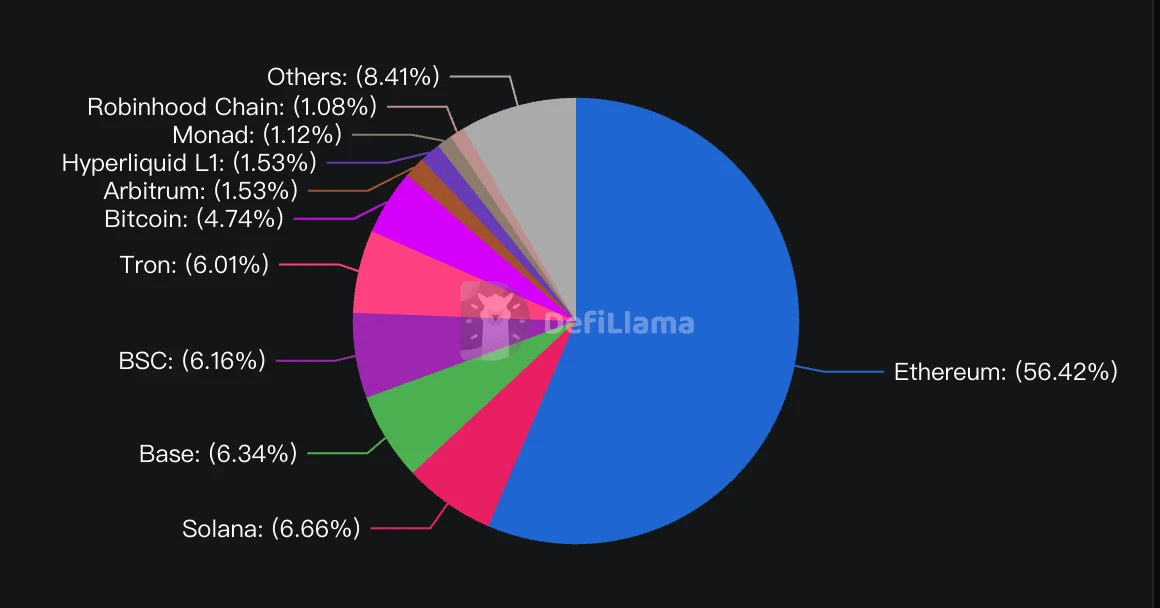
Facing increasingly fierce competition, the development paths of blockchains have also begun to diverge. Compared with general-purpose blockchains that try to cover all application scenarios, vertical blockchains built around specific needs and driven by real applications to attract users and liquidity are becoming the mainstream direction of exploration in the industry. Some established blockchains have also begun pivoting to niche tracks such as AI and payments, seeking new growth space through differentiated positioning.
But whichever path is chosen, a sustainable business model must be established. For crypto projects lacking a steady source of income, funding reserves and token sale proceeds may support team operations in the short term, but they cannot replace stable operating cash flow. Once fundraising is blocked and cash reserves keep being consumed, a project may be forced to cut spending, scale back development, or even shut down entirely. Linera's experience is a real-world case: financing can buy a project time, but it cannot indefinitely replace its own ability to generate revenue.
What is even more noteworthy is that the market's logic for valuing blockchains is also changing. In the past, technical narratives, funding lineups, ecosystem scale and airdrop expectations were often enough to bring attention and valuation premiums to a project. But as more projects enter actual operation, the market has begun to re-examine how much of this growth comes from real demand and how much relies on short-term incentives.
While on-chain transaction volume and TVL remain important indicators of ecosystem scale and user activity, they do not necessarily mean a project has sustainable profitability. For investors, whether a protocol can continuously generate revenue, and whether that revenue can be effectively passed on to token holders, is gradually becoming an important dimension for evaluating projects.
Recently, the strong performance of tokens such as Hyperliquid, Uniswap, NEAR, Venice, Arbitrum, Aave and Lighter further reflects the market's growing emphasis on aligning protocol revenue with token incentives.
It is precisely for this reason that more and more crypto projects are now trying to link protocol operations with token value through mechanisms such as token buybacks and burns. According to Unfolded data, crypto projects have spent $638 million on token buybacks so far this year, up from $545 million in the same period last year, while the figure for the same period in 2024 was only $366,000. Among them, Hyperliquid and Pump.fun together account for nearly 90%.
But buybacks themselves do not equal sustainable value capture. Their actual effect still depends on the source of funds, the scale of buybacks, changes in total token supply, and whether the project can continue to generate revenue in the future. Without stable operating cash flow, buybacks may only be a phased value expenditure and are unlikely to serve as long-term support.
Ultimately, when narratives and technical halos are no longer enough to attract liquidity, blockchain competition is shifting from competing for traffic and market attention to a test of real demand, sustained revenue and the ability to return value.